Menu

Show posts

This section allows you to view all posts made by this member. Note that you can only see posts made in areas you currently have access to.

Show posts Menu

Messages - gamer0004

#1
I didn't say insider trading was against basic economics, I said I hadn't heard of anyone in favour of it. When you pointed out there were people in favour of it, I immediately accepted this.

Massive debt is not printing money. And your argument is still "it didn't work in history". This still doesn't change the fact that what is going on today never happened in history either, so the two are not comparable. And that besides the fact that there are obvious difficulties in determining causation: empires which had big difficulties might be inclined to use paper money. And apart from that, not a single big civilization survived to today, including the ones which never used paper money. The comparison is, in other words, utterly useless.

Governments protect people against violence by using violence. It protects the value of money by keeping it valuable. It's both government intervention by using force. If you're against monetary government intervention then that's a reason why the gold standard would be better, because it limits the options of monetary intervention (though as I said, they can simply drop the gold standard at any time so it's not that stable either). But that's not a reason why "paper money doesn't work". You can say that governments are bound to misuse the power they have when using paper money. You can prefer the gold standard. But these are opinions, and they don't change the fact that paper money works.

And your videos are not the truth, they are made by the very same person who makes extremely elementary mistakes and as such do not hold value. I prefer to base my opinion on decades of proper economic research, backed by proper econometrics, thank you. Of course I do listen to different opinions, but none have convinced me so far, and yours certainly won't convince me if you keep making these basic mistakes. Apart from that, it's obviously pointless to argue that you're right because in your mind all economic phenomena work differently then they do. That's the same argument religious people use: their ideas are correct because the bible says so. That doesn't work. And you don't have to show me your videos because I understand how things work, thank you. Have you already read a modern macroeconomics textbook yet? Explain the IS-LM model. And the AS-AD model.

Production as measured by GDP measures production, which measures what people can buy, ultimately, irrespective of who is buying what (like I said, a GDP of $600 in the Chinese empire was mostly because of the rich elite (the government) being relatively rich). And your problems understanding GDP or your conceptual issues with GDP (and there are conceptual difficulties, obviously) don't change the fact that compared to the Chinese or the Roman empire, everybody is better off (except maybe a few drug addicts). Even if you are right about GDP (which to some extent you are), this is in favour of my argument that our economy produces far more per person, and that people can consume far more per person. Production in our economy is far higher (again, GDP measures production! Not consumption!) because our economy is fundamentally different. As such, it can't be compared to economies of ancient civilizations.

And again, you keep saying you have lots of explanations and facts, but where are they? Quote them directly or write them down. It's no use to me if they're in your head. (for instance, give me all empires and their financial history, why you think the switch to paper money led to their downfall, give me proper sources, and then explain why it would be a good comparison in the first place, since our economy is so different (far higher production per capita).
#2
I can be short about this. There was inflation in Spain, and they didn't print any money (this is the 16th century we're talking about here). The fact that there are Nobel prize winning economists in favour of the gold standard doesn't mean you're right. Other Nobel prize winning economists (Paul Krugman) are opposed to it.

But again, I'm not arguing specifically in favour of paper money or against the gold standard. What I'm arguing about is the fact that you make elementary mistakes in claiming that paper money doesn't work. And talking about claims to authority: I have almost every economist, Nobel prize winning or not, in support of my point, because it is just basic economics. Your idea of "paper isn't worth anything so it can't work as money" was one of the reasons why the gold standard was kept for a long time, but after WWII it wasn't used as an argument anymore, because science has progressed. We now know that it's not about how valuable the commodity is what the money consists of, because money can have it's own value for just being money.
Your argument is basically that paper money doesn't work because it requires coercion from the government (and in the video that it's value is determined by production, which I've already dispelled). Yet the whole economy, that very same free market system you so love, only works in combination with government coercion. That is again basic economics. Without a legal system (which is government coercion), without a police force (which can even use physical violance - again, coercion) an economy cannot develop, because people have to consume everything immediately, because otherwise it can be taken away. This is the exact reason why countries in Africa which have a weak and corrupt government do not develop, despite development money from rich countries and investments from some companies.

Also, it was GDP per capita, in constant dollars, adjusted for PPP. So it represents how much people could buy (how much food and clothes and all that) and nothing else (a government printing money doesn't change GDP per capita adjusted for PPP). That said, there are obviously limitations to measurements of GDP. GDP is not a social welfare function. It is simply an aggregate of economic activity, and if economic activity increases, the economy grows. That doesn't mean people are better off, but it does mean the economy has become bigger. And considering how low their production (a small 'economy per person' so to speak) was, they didn't have a lot of food and other commodities, and we do (in the Chinese Empire, farmers didn't even eat any meat. I can now, as a student, easily eat meat two times a day).

You are saying "I have tons of facts" but you're not showing me any. Until then, I think we can safely assume you don't, because you can't even understand basis economics.
#3
Okay, so I'm not going to be nitpicking single lines because that way there's not going to be a constructive debate, which you don't seem to be interested in.

You should learn more about history. List of historical GDP per capita. Roman Empire, Chinese Empire: all very impressive isn't it? It is, but even they did not manage to achieve a level of GDP per capita far above subsistence level (which is about $400 in those numbers). The average is higher because there was a rich elite, but the rest of the population was still around subsistence level.
Since about 1500 A.D., things have changed. There has been sustained growth, something which has never happened in history (not that average GDP per capita was lower in the year 1000 A.D. than in 1 A.D., and that both averages are only slightly above subsistence level).
I'm saying we should all be farmers because historically there has never been any such thing. According to your reasoning (it didn't work before, so it won't work now) this would be impossible. Historical facts should always be examined very critically. Our economy is different, our financial system is different (regardless of gold standard) and as such, a different system might work.

The fact that our paper money system requires government force and as such is unstable is, again, nonsense, for our whole economy (both the financial and the 'real' part of it) require government force. Without the government forcing people to comply, it can't function. Again, basic economic theory (property rights) and common sense.

Also note that I'm not really in favour of either, because this is not my field of expertise. However, you present your opinion as fact, and do so by making elemental mistakes. That's what I take issue with.

And when I see your reaction, I think I better stop here. By taking apart my argument you're completely missing the point and mistake what I'm saying. Sentences follow each other for a reason. I do not write in bullet points. For example, when I say "The precise problem is that you want to "keep the system in balance". the system isn't balanced" I was not talking about our financial system, but about our economic system, our ever increasing production.

Your responses to my post are not backed by any facts. You're arguing that paper money is unstable. I argue why it's not, that it does have value, to which you then reply that it doesn't. That's not arguing. That's just repeating your initial statement over and over again. You accuse me of not having any sources, but where are yours? I have at least a few facts though I don't think they're decisive, you have shown none. All you do is denying any points I make without arguing why. Your initial argument being that paper money doesn't work because it only has value because of coercion by the government and that historically this has always failed, you go on responding to my points with:
-It has NO value absent the force of government. That makes it duress.
-No, it MUST have value ABSENT force or else it WILL be an unstable currency that sends a civilization into ruin. We've seen this in history time and time and time again.
-Because it's a fiat system manipulated by government!
Which is nothing but exactly repeating what you initially said. Still no proper rebuttal, no facts, no reason why I'm wrong or why you're right. Only the same argument, over and over.
Then you have a completely wrong concept of deflation, thinking it is beneficial to lower and middle class, again giving no reason why this would be, and completely ignoring the very basic fact that if money buys more products in a few months (which is the concept of deflation) that people are going to consume less, which will reduce production and, as such, income (it will also lead to unemployment, for wages rise and typically can't be cut, because employees tend not to accept that. As a result, labour becomes expensive and will be replaced by capital, which does get cheaper because of deflation).

Some other great rebuttals supported by facts:
-NOT true.
-No, it's because government wanted to spend beyond their means. And it's brought us to financial ruin.
And one not supported by any source:
-Oh, INCREDIBLE ignorance! 1) The GD was caused by fiat money inflating the markets and creating the bubble. 2) The gold standard WAS NOT FOLLOWED as the Fed didn't react to the gold exchange like they were supposed to. 3) In 1933 FDR made it ILLEGAL FOR PEOPLE TO OWN GOLD, thus completely abrogating the gold standard. (And manipulated the price of gold based on things like superstitious lucky numbers!)

(note that from 1933, the economy was finally growing again...)

What I'm talking about is not about facts. It is not about history. It is about elementary economics. Read literally any modern textbook on macroeconomics and you'll understand why you're completely wrong. But until we're discussing things from the same framework (which you can criticize, I don't agree with everything I learn either) it's useless to go on. I can't teach you decades of economic research in a few forum posts, and I'm certainly not willing to do so. Once you are familiar with basic concepts such as the IS-LM model and its underlying concepts and the AS-AD model and its underlying concepts we can discuss this. You need to understand how things work before facts are of any use.

GDP per capita is still growing. This generation will be better off than previous generations unless things go really bad, but there is absolutely no reason to assume they will, unless you rely on historical evidence which is not representative for our situation. (and again, you use this as an argument why I'm wrong, but this argument is only based on your initial statement).

And the labour theory of value is outdated because it doesn't work and it has never worked - not because times have changed. Science has progressed. You are talking about the value of gold and how it is determined by its scarcity and the required input to obtain it. This is similar to the labour theory of value and it is utter bullshit.
As for what determines value: I said that if the supply of money does not increase, while production increases, this will increase prices, to which you said that it was wrong and the value would go up.
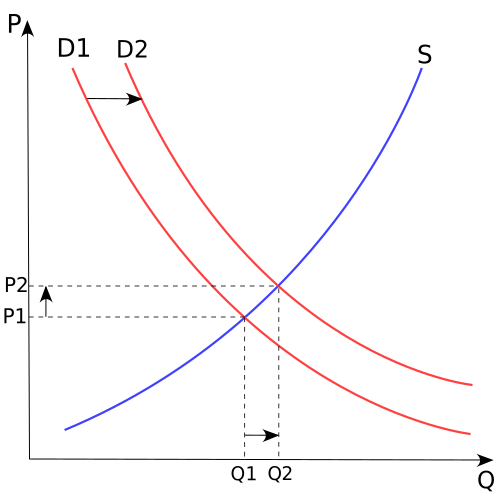
This is really unbelievable. surely you understand the concept of supply, demand, and equilibrium price? Supply doesn't increase, demand increases, this increases price. Simple as that.  As you seem to be unable to understand this incredibly simple and elementary concept of economics, here's a nice graph:

And no, I'm not going to provide you with facts, because this is just economic theory. The demand increases, this means the demand curve shifts to the right (it is not a change on the demand curve because the increase in demand is not the result of a change in price), supply remains the same, price goes up (to P2). Supply of money is usually pretty much fixed unless the government intervenes, which would result in a vertical supply curve, but the result is the same: price goes up. Simple, isn't it?

As for the concept of value, it depends on how it is defined (yes, nuances, how terrible!). There are different ideas about this. It can be taken to be price. It can be taken to be how much of one good people are willing to give up in exchange for another good (which would be the same as price in a perfectly competitive market characterized by perfect rationality and information, which does not exist in the real world, so there are some differences in practice). The latter depends on the marginal utility of the two goods. The utility curves determine the demand curve. In the model of a perfect economy, as I said, relative prices and relative marginal utilities are the same for every actor involved, because this model only explains the allocation of goods. The supply curve therefore depends on marginal utilities and the initial allocation of goods. There is a different supply curve when production is possible (which ultimately depends on marginal utility as well).
Value ultimately depends on the utility the good offers me. In case of gold or dollar bills (if used for buying other goods), the worth is equal to the goods I can buy with them (or the utility the 'consumption' (jewellery) of gold offers me, if that is higher than the utility of the goods I can buy with that gold).

Talking about fallacies: you're claiming I'm ignorant of history. I'm not. I read a lot about history, as I find it very interesting, and I do a large minor exactly about these kind if things, that is: economic history. Another great example of an ad hominem is accusing me of being a creationist, which has nothing to do with this (and is of course not true). I'm just not interested in having to go through hundreds of pages of macroeconomic theory just to get you at some level of understanding of what we're talking about.

As for the gold standard, as I have always understood it, and a very quick wikipedia search tells me I'm right (can't be bothered looking for a better source), the gold standard means the government backs the money with gold, so people can buy gold with their currency. This to ensure people perceive the value of their paper money to be more tangible (or real). AFAIK it does not go the other way round (people selling gold for dollars) on a regular basis. Also note that during crises, governments often refused to exchange their currency for gold. So it's not a failsafe alternative either.

Last but not least, the huge increase in bullion in Europe due to the findings of silver and gold in South-America led to lots of inflation, especially in Spain. Gold is not stable either, though there are less opportunities for governments to influence their economies and finance. Still, governments can decide to stop exchanging currency for gold, as they've done in the past, so that safety mechanism is not that effective either.

Start coming with real arguments instead of repeating your initial argument over and over again, come up with facts that back your ideas and show me why decades of macroeconomic theory are wrong and we can continue discussing this. If you don't, I won't take the effort to continue responding to your nonsense.
#4
Quote from: surhotchaperchlorome on March 03, 2012, 04:37:08 PM
This is a misconception I've seen many Austrians have as well.  It boggles the mind why so many people view money--especially free market money as some top-down thing that is more rigid than a pillar of ice near 0 Kelvin.

It depends on the system and what your definition of money supply is. In any case, it is very inflexible, to the extent that even governments can't sustain it beyond a certain level of production.

Oh and @MrBogosity: thanks, and I'm sorry for the "idiot" part. I wouldn't have called you that in your face (because it's impolite, not because I'm afraid of you :P). I didn't mean you're dumb, but you are presenting your opinion (gold standard is good) as fact, and you made some elementary economic mistakes (like the claim that value depends on inputs...). It's an interesting debate though.
#5
Quote from: MrBogosity on March 03, 2012, 02:41:12 PM
No, it doesn't, as I showed in the video. It's not a store of value, so there's nothing protecting its worth. Whereas gold always, always, ALWAYS represents the amount of resources needed to mine an equivalent amount. If at any time you need an ounce of gold for something, you don't have to get together all the resources and take the time and labor to mine it; you just get it off the market.
That's not a high market value; that's duress.

Like I said, this is a woefully outdated concept of value. Value is not the same thing as price. Prices, in a perfectly competitive market, will be close to cost of production. Prices are determined based on supply (which is determined by production costs) and demand (which is determined by (marginal) utility, or the (marginal) value a good has to consumers).
Paper money does not have high value because of 'duress', it has value. I want the money. It offers value to me. That's all that's necessary. The fact that the government ensures that money retains its value is a good thing, just like a government which ensures that my stuff isn't stolen, which is required for an economy to function. That's another important task of the government, and it is coercion, but it too is a good thing. Don't be so paranoid about your government (I assume the US government? It has some really nasty features, but it's still better than many authoritarian regimes or no government at all).

Quote from: MrBogosity on March 03, 2012, 02:41:12 PM
I DO want the gold standard because there's a limited supply of gold! And because there are entrepreneurs who are ready to trade gold between the currency window and the commodity market to keep the system in balance.

[citation needed]

Roger Backhouse, The penguin history of Economics (which I can recommend, it's about the history of economic thought and a lot of really interesting concepts are discussed, including the labour theory of value. You'd better drop that BTW, as that's precisely what Marx based his theories on!) and Niall Ferguson, the ascent of money (p. 25). I can also recommend the latter, especially regarding the gold standard and other concepts.
The precise problem is that you want to "keep the system in balance". the system isn't balanced. This is the first time in history that mankind has seen sustained economic growth (since about 1500 A.D., which accelerated during or after the industrial revolution). Increased production requires more money, because total transactions in one year are higher (in dollar value, or whatever other currency is being used). If the supply of money does not increase (or increase only slightly), as is the case with a gold standard, this increases the price of money (which sounds weird but isn't). The result is deflation and increased interest rates. People keep their money without spending it, companies have to pay a higher interest rate to compete for scarce money (which is made scarcer because simply keeping the money instead of investing it becomes relatively more attractive), and this reduces both consumption and investment, with a lower Y as a result. I'm not sure whether it is possible to buy gold and sell it to the government for money when there is a gold standard. If it is, it is still an inflexible system, made worse by deflation: buying gold two months later will increase the amount of gold one can buy. The result is a deflationary spiral. May I remind you that the gold standard made the Depression even worse?

Quote from: MrBogosity on March 03, 2012, 02:41:12 PM
The only such lack I'm aware of is because government taxed people so much they no longer had much. But the government and their cronies certainly had enough!

Deflation does NOT happen because the economy grows. As I show in the video, what REALLY happens in that situation is that capital is freed up and can be used for other purposes. Printing money to offset that just means the poor, the middle class, and small businesses are robbed of the benefits of this.

If that happens in a gold standard, then people will buy gold from the commodity market and turn it in for money, providing the economy with the extra money it would need in such a situation. You seem to be under some kind of impression that the money supply never, ever changes in a gold standard. Nothing could be further from the truth. It just seeks equilibrium, as opposed to fiat money which seeks the appropriation of wealth for the government and its cronies.

No, they aim for inflation because they get rich doing it. At OUR expense.

I'm not going to watch that video, as it is a video by you and I'd probably disagree, and I'd rather stick to the current discussion. It seems you have a very unhealthy stance towards government, which severly clouds your judgement. The government is not there to make money. It, in fact, loses money, what with the deficits and all. Deflation does not "free up capital". Inflation does not make "the government and its cronies" (whoever they may be) rich. It does makes debtors better off, but a constant inflation will simply be compensated by an equally increased interest rate.

Quote from: MrBogosity on March 03, 2012, 02:41:12 PM
Bullshit. So you know fuck all about numismatics as well. Let me educate you. Coins can have three values: commodity value, face value, and collectible value. Commodity value would be the value of the gold in the case of gold coins. But they have a SLIGHTLY higher face value, because of the process involved in minting the coins. When they have a MUCH larger face value, it's because of their value as collectibles, NOT as money, and they have value the way rare stamps do.

The Roman empire started increasing the difference between commodity and face value of the dinarius by slowly reducing the amount of silver in it. Go research what happened--it's Gresham's Law in action!

How come EVERY society that used paper money ended up in financial ruin within a century or so? Whereas gold has remained a stable currency for millenia? Even today gold is the second most popular form of money in the world!

(Gold coins can be worth far more than the value of the gold they consist of, depending on government regulations. For examples I refer to the books above.)

According to your logic, we should now all be subsistence farmers. Because how come EVERY society in history which increased its standards of living collapsed within a few hundred years?
Our society, our economy, our science, our technology, our knowledge and our production is different. We (our capitalistic, western civilization) have a modern economy which is completely different from other civilizations, which is a result of flexible finance and which REQUIRES flexible finance. The gold standard is particularly ill suited for a modern economy.

There is a reason we let it go. Not necessarily because governments (the people you love ;)) wanted it, but because they had to. It was unsustainable in our modern globalized economy.
#6
I registered specifically to debunk some bullshit about economics. I don't know what this forum is about or whether the person who replied to my original post shamelessly copied here is the person who made the video I was replying to... but here ya go.

Quote from: MrBogosity on March 03, 2012, 12:18:40 PM
And if a frog had wings he wouldn't bump his ass a-hoppin'.

The thing is, we have seen this with paper money every single time it's been tried. We haven't seen it with gold ONCE.

The whole "there isn't enough gold" canard just shows how ignorant the person is. The whole POINT of money is that there's not a lot of it!

The whole point of money is to facilitate trade. The point of money is not that there isn't a lot of it. We don't - typically - use diamonds as a means of paying. We certainly don't use my shit as a way of paying. It's certainly rare, as I'm the only one producing it, but it's not valuable. To facilitate trade, money requires certain characteristics, as demonstrated in the video. Paper money meets these characteristics. Paper itself doesn't, because it doesn't have a high market value. Paper money does have a high market value, because people are obliged to accept is as payment, and because people can use it to pay other people. I myself am more than happy to accept digital numbers on my bank account in exchange for labour performed, since I can use that money to buy nice stuff. I cannot do so with, for instance, toilet paper. It's paper allright (BTW, paper money is not, in fact, made of paper) but it doesn't have nearly as much value because I can't use it to pay. It has value because people think it has value and vice versa, and the government ensures it keeps its value.

Of course, if the government decides to print more money, the result will be that value goes down. If they do it very often, people steer clear of paper money entirely, because people perceive it does not retain its value, and as such it loses its value.

You don't want the gold standard because there is a limited supply of gold. Throughout the middle ages, there were great problems with a lack of bullion. The supply of money was too small to facilitate all profitable trading opportunities. This hampers growth. When the economy grows, the supply of money should grow as well, because more trade (in dollars) will take place. If supply doesn't grow, money becomes more valuable. Which is deflation. Which hampers growth to great extent. Deflation causes lots of problems. If money becomes more valuable every year, people are inclined to keep it instead of spending it. You probably know that deflation is a bad thing, and otherwise you should look it up. This is one of the reasons why central banks aim at an inflation of about 2% instead of 0%.

Quote from: MrBogosity on March 03, 2012, 12:18:40 PM
Yes, gold is EXCELLENT as a store of value--and as I said in the video, that's one reason it works GREAT as money.

What makes this such an incredible fail is that he preceded it with the most important way paper money IS different from commodity money!

Bullshit. It's just someone typing a number in a computer. How much more difficult is it really to type a big number than a small one?

Ignoring all the reasons I DID give for it. And there are PLENTY of economists who say it's a good thing, not the least of which was Milton Friedman.

The big difference is that gold has a relatively large exogenous value, whereas paper money has a small exogenous value. This is a big difference, but it doesn't make them different in nature. Printing money still requires resources. It requires less resources than mining and refining gold ore, but it still isn't free. But that isn't relevant, since mankind has known for about two hundred years now that value is not derived from inputs.
To give another example as to why the difference isn't essential, gold coins were often worth far more than the value of bullion it consisted of. That's the effect of supply and demand for money. In some cases, the amount of gold or silver in coins was very low. Just like the value of the 'paper' in paper money is very low.

The notion of "paper money can't work because paper isn't work anything" is a thousands year old myth. One of the reasons why the church (and the Islam still today) was against charging interest was because money was seen as sterile: there is a certain amount of gold, which has a constant value, and as such charging interest is theft, because it reduces the amount of money available to the society in favour of those charging interest.
Have you ever noticed how economic development didn't really go anywhere the thousand years before the financial revolutions in Italy, the Dutch Republic and England?

I'll give you this: the value of paper money is more volatile than gold or money backed by gold. There are risks of hyperinflation and there is typically sustained inflation. These are good arguments for the gold standard. But paper money works, just like gold works or money backed by gold. The principle is the same in all cases: a means of payment which is worth the same amount of goods for all people. The devil is in the detail, not in principle.

As for insider trading, I was perhaps a bit too fast in my response that everybody is opposed to insider trading. I don't think insider trading is a good idea, because it increases risk for anybody except insiders, and because these insiders can exploit asymmetrical information, which might result in a lemons market. Considering the fact that most countries have forbidden insider trading, I guess there are good reasons to do so, but apparently some people argue in favour of it. I do not know that much about it and as such will not be arguing against insider trading any further.